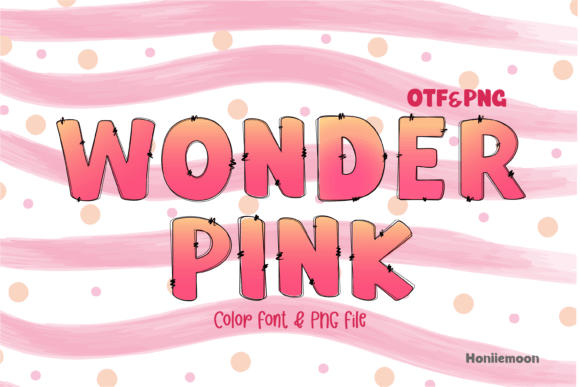
Wonderpink: Where Playful Typography Meets Festive Design
There's a particular kind of design challenge that comes with projects meant to feel celebratory, warm, and unmistakably personal. You need typography that carries emotion without sacrificing clarity—fonts that feel handcrafted yet polished enough for professional use. That tension between authenticity and refinement is exactly where Wonderpink Creative Alphabet Fonts finds its sweet spot, offering a collection that bridges the gap between casual charm and commercial-grade design.
A Typeface Family Built for Moments That Matter
Wonderpink isn't a single font. It's a curated system of creative alphabet styles spanning handwritten, display, and decorative categories. Each style within the collection carries its own personality, yet they share a visual DNA that makes them work together naturally. The handwritten variants feel warm and approachable—think of the lettering you'd see on a boutique bakery's chalkboard menu or a greeting card that actually makes someone smile. The display styles lean bolder, designed to command attention on posters, signage, and packaging where legibility at scale matters. Then there are the decorative options, which bring flourishes and character to projects that need something truly distinctive.
What makes this particular collection worth examining is how it handles color. As an OpenType-SVG color font, Wonderpink ships with built-in color information embedded directly into the letterforms. Install it the way you would any standard font, and you immediately have access to multicolored characters without needing to manually layer effects or apply gradients in post-production. For designers working in Adobe Photoshop (CC 2017 and later), Illustrator, Silhouette Studio, or Inkscape, this means a significant reduction in production time for colorful typographic treatments.
Practical Applications Across Design Disciplines
The versatility of a font collection like this becomes apparent when you start mapping it against real project types. Consider branding work for a small business launching a seasonal product line. The handwritten style might anchor the primary logo during a holiday campaign, while the display variant takes over packaging headers and point-of-sale materials. Because the styles share underlying proportions and weight distribution, switching between them maintains visual cohesion even as the tone shifts from intimate to bold.
Social media managers face a constant need for fresh visual content that stops the scroll. Wonderpink's decorative styles work particularly well for Instagram story templates, Pinterest graphics, and promotional banners where a single word or phrase needs to carry the entire visual message. The color font capability means you can create vibrant, eye-catching text treatments without additional design steps—a practical advantage when you're producing content at volume.
For invitation designers and event planners, the collection addresses a longstanding problem: finding fonts that feel festive without crossing into novelty territory. Wedding invitations, birthday party announcements, holiday greeting cards, and corporate event materials all benefit from typefaces that signal celebration while maintaining readability. The handwritten and decorative styles in this collection thread that needle effectively, offering enough personality to set the mood without overwhelming the supporting text or competing with other design elements.
Packaging design presents another compelling use case. Artisan food brands, cosmetics companies, and specialty product manufacturers often need typography that communicates handcrafted quality. Wonderpink's script and handwritten styles deliver that handmade aesthetic while remaining consistent and reproducible—something actual handwriting can't guarantee. When you're printing thousands of labels or boxes, consistency matters as much as character.
Making Smart Typography Decisions
Choosing the right font style from any collection requires thinking beyond personal preference. The decorative variants in Wonderpink, for instance, work beautifully for headlines and hero text on posters or digital banners, but they'd create readability problems in body copy or lengthy paragraphs. Reserve those high-character styles for short, impactful text moments. Pair them with a clean sans serif or a straightforward serif font for supporting content, and you'll create visual hierarchy that guides the reader's eye naturally.
Font pairing is where many designers—especially those newer to typography—stumble. A common mistake is combining two fonts with similar visual weight or personality. If you're using Wonderpink's handwritten style for a headline, try pairing it with a geometric sans serif for body text rather than another script or handwritten typeface. The contrast creates breathing room and makes each font's role in the composition immediately clear.
Readability testing deserves more attention than it typically gets. Before committing a font to a final design, view it at the actual size it will appear in context. A decorative alphabet that looks stunning at 72 points on your monitor might become illegible at 14 points in a printed brochure. Check how letter spacing holds up, whether similar characters remain distinguishable, and how the font renders across different devices if the project includes digital applications.
Understanding the Technical Landscape
It's worth noting the compatibility specifics that come with color fonts. Wonderpink's OTF and PNG files install like standard fonts, but not every platform supports OpenType-SVG color rendering. Canva, despite its popularity among non-designers and small business owners, does not currently support color fonts. If Canva is your primary design tool, you'll want to use the included PNG files as an alternative or consider working in a compatible application for the typography elements of your project.
Cricut users should also be aware that the OTF and TTF files in this collection are not compatible with Cricut Design Space. For crafters who rely on cutting machines for physical products like vinyl decals, iron-on transfers, or paper crafts, this is an important consideration during the planning stage. The PNG files can serve as a workaround for some applications, though the workflow differs from working with native font files.
For those working in Adobe Creative Suite, Illustrator and Photoshop both handle color fonts well in recent versions. The ability to treat these as standard fonts—scaling, kerning, and adjusting them through normal typographic controls—means they integrate into existing workflows without requiring specialized knowledge or additional plugins.
Building a Cohesive Visual Identity
One of the less obvious advantages of working with a font collection rather than a single typeface is the flexibility it provides for building visual systems. A brand that uses Wonderpink's display style for its primary logo can extend the handwritten variant to social media captions, the decorative style to seasonal campaigns, and still maintain a recognizable typographic identity across all touchpoints. This kind of internal consistency strengthens brand recognition over time—your audience begins to associate specific visual patterns with your business, even if they can't articulate exactly why.
For content creators building digital products—templates, printables, planners, or educational materials—the commercial licensing that typically accompanies premium font collections like this one removes a significant barrier. Knowing you can legally use the fonts in products you sell, rather than limiting them to personal projects, changes the calculus of which design assets are worth investing in.
The practical reality of modern design work is that typography choices ripple outward. A font that works across multiple project types, maintains its character at different scales, and offers enough variety to prevent visual monotony is genuinely useful. Wonderpink's strength lies in that combination of personality and practical range—not trying to be everything, but covering enough ground to handle the festive, celebratory, and personality-driven projects where standard corporate typefaces fall flat.
Whatever your role—designer crafting brand identities, entrepreneur launching a product line, or hobbyist creating invitations for your next gathering—the value of a font ultimately comes down to whether it solves real problems in your actual workflow. Test it against your specific needs, check the compatibility requirements against your tools, and evaluate whether its visual character genuinely serves the projects you're building. That practical assessment matters far more than any marketing description.